
What Is a Gen Z Bible Translation?

A Gen Z Bible translation is a paraphrase of the Bible in the everyday language and texting style of people born roughly between 1997 and 2012. It starts from an existing English translation and restates each verse in casual modern words. Nobody goes back to the Hebrew and Greek manuscripts to make one, so it works best as a companion to a standard Bible.
That detail shapes how you should use it. Below you'll find where the trend came from, what critics get right, and a simple way to read a slang paraphrase while keeping hold of what the text actually says.
Where the Gen Z Bible translation trend came from
Around 2024, TikTok creators began posting Bible stories and verses rewritten with words like lowkey and no cap. Some clips were jokes. Others came from people who said it was the first time a passage had made sense to them. News sites picked up the story, and searches for a full Gen Z Bible took off.
The idea itself is older than TikTok. Kenneth Taylor published The Living Bible in 1971 because his kids struggled with the King James wording, and Eugene Peterson finished The Message in 2002 after years of rephrasing Scripture for his congregation. A slang version is the newest entry in a long line of paraphrases written for a specific audience.
Is a Gen Z Bible version a real translation?
Bible versions sit on a scale. At one end are word-for-word translations such as the ESV and NASB, which follow the structure of the original languages closely. In the middle are thought-for-thought translations like the NIV and NLT, which aim for natural English. Translation teams at both points work directly from Hebrew, Aramaic and Greek texts, often over many years.
A paraphrase lives at the far end of that scale. One writer, or a small group, takes an English Bible and reworks it into a different register. The Gen Z version belongs here. It can be useful and even moving, but it carries more of the writer's interpretation in every line, and it should be read with that in mind.
The fair criticism of Gen Z Bible paraphrases
Pastors and scholars have raised real concerns, and they deserve a hearing. Slang dates quickly, so a phrase that lands this year may sound odd in three. Casual wording can also flatten tone. A psalm of grief written in meme-speak risks reading like a punchline, and the weight of a passage like Lamentations can get lost.
There is also the question of who wrote it. Some versions online were generated by AI with no review at all, which means errors slip through unnoticed. When one person's interpretation replaces the text, readers can end up trusting the paraphrase more than the Bible it came from.
On the other side, making Scripture understandable is an old and good instinct. When Ezra read the law to the returned exiles, the Levites explained it so ordinary people could follow:
“They read in the book, in the law of God, distinctly; and they gave the sense, so that they understood the reading.”
Nehemiah 8:8 (WEB)
How the Gen Z Bible app handles translation
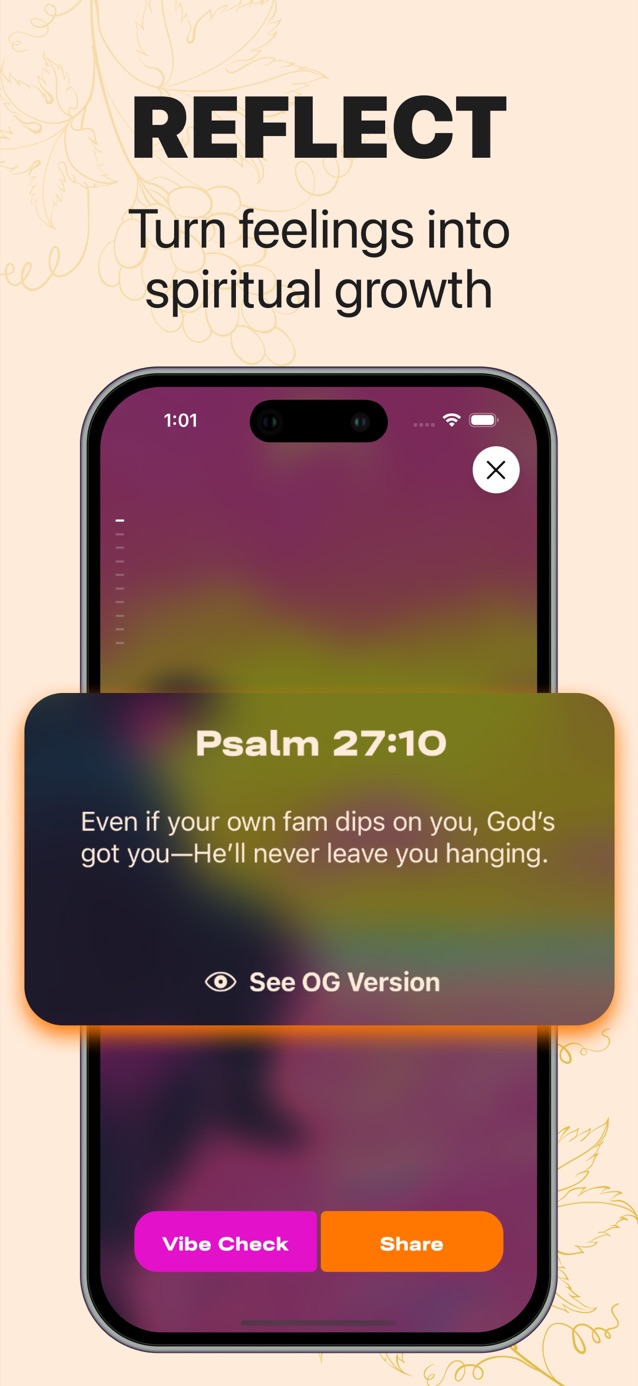
The Gen Z Bible app puts the paraphrase and the original text on the same screen. Open Psalm 27:10 and you'll see this line: "Even if your own fam dips on you, God's got you. He'll never leave you hanging."
For comparison, the World English Bible renders the verse below. The meaning carries across (a parent's rejection, God's faithful care), while the wording and tone shift a lot. Tapping See OG Version swaps the paraphrase for the original verse, so checking the wording takes one tap. Below the verse sit a Vibe Check button, for the app's SOAP-style reflection, and a Share button for sending it to a friend.
“When my father and my mother forsake me, then Yahweh will take me up.”
Psalm 27:10 (WEB)
How to read a Gen Z Bible translation responsibly
A paraphrase is a good door into a passage. A standard translation is where you check that you walked through the right one. A simple routine keeps both in view:
- Read the standard translation first. Use the NIV, ESV, NLT or WEB, then read the slang version as a second pass.
- Compare line by line. Look for anything added or softened. If the paraphrase says something the original doesn't, trust the original.
- Read the whole chapter. A single verse out of context is easy to misread in any version. Psalm 27 is 14 verses and takes about two minutes.
- Write down one observation. The SOAP Bible study method gives you a four-step template for this.
- Ask someone when a line puzzles you. A youth pastor or a friend who reads a lot can help.
Who a Bible in Gen Z slang helps most
The slang version helps most when the old wording is the thing stopping you. If you tried Genesis once, hit a wall of begat and thee, and closed the app, a paraphrase can get you reading again. It also helps when you're sending a verse to a friend who has never opened a Bible and would scroll past formal English.
Over time, most readers find they want both. The paraphrase gets the idea across fast, and the standard translation rewards slower reading. If you're new, our guide on how to start reading the Bible suggests which books to open first.
“Your word is a lamp to my feet, and a light for my path.”
Psalm 119:105 (WEB)
Questions people ask
Is a Gen Z Bible translation the same as The Message?
Both are paraphrases, so they sit at the same end of the translation scale. The Message was written by one pastor over about a decade in contemporary American English. A Gen Z paraphrase uses current slang and texting style, which makes it more casual and quicker to date.
Can I use a Gen Z Bible paraphrase in a Bible study group?
Yes, as a second voice next to a standard translation. Reading the slang version aloud after the NIV or ESV often starts good conversation about what a verse means. For close study of a word or phrase, rely on the standard translation.
Scripture quotations are from the World English Bible (WEB), which is in the public domain.